
Solar Eclipses of 2027 and 2028 on the Costa Blanca-Alicante: We will look to the Sky again 🌘
Solar Eclipses of 2027 and 2028 on the Costa Blanca-Alicante: We will look to the Sky again 🌘
Do you still remember the excitement of the August 2026 solar eclipse? 😍
🕶️ Keep your certified solar eclipse glasses safe, because the sky still has two extraordinary surprises in store for us: a partial solar eclipse in 2027 and the spectacular “Ring of Fire” eclipse in 2028 ☀️ According to information published by Spain’s National Geographic Institute (IGN), these astronomical events form part of the Iberian Eclipse Trio of 2026, 2027 and 2028. This exceptional succession of solar eclipses is turning Spain into one of Europe’s most privileged destinations for stargazing and eclipse tourism 🔭
😎 In Alicante, Calpe, Benissa, Benidorm, Villajoyosa, Elche, Altea, Teulada-Moraira, Jávea, Dénia and other destinations across the Costa Blanca, we will once again look to the sky and share one of those rare moments that remain in our memories for years 🍷 Save the dates! ✨
💫 VIP BOOKING: Experience the solar eclipse from a private sailing boat in Jávea, Calpe, Moraira or Altea ⛵✨
🌒 Partial Solar Eclipse on 2 August 2027
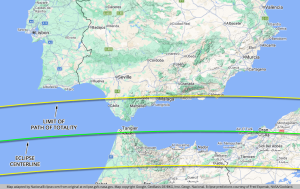
On Monday, 2 August 2027, a total solar eclipse will take place. However, the path of totality will only cross southern Spain, particularly Cádiz, Málaga, Ceuta, Melilla and parts of Granada and Almería. According to astronomical data from Spain’s National Geographic Institute (IGN), the 2027 eclipse will be visible as a partial eclipse from the Costa Blanca. In 2028, however, Alicante will lie within the path of annularity, where the long-awaited “Ring of Fire” will be visible ☀️
✨Across the Costa Blanca, we will experience a very deep partial solar eclipse. In Alicante, it will begin at approximately 9:46 a.m., reach its maximum at 10:54 a.m. and end at around 12:08 p.m. 🌘How much of the Sun will disappear? The predicted eclipse magnitude in Alicante is 0.948. Put simply, the Moon will cover approximately 94.8% of the Sun’s diameter ☀️
It will be almost total, but that “almost” makes an important difference 🌒 On the Costa Blanca, complete darkness will not fall, and a small part of the Sun will remain visible throughout the eclipse 🌘 Even so, we may notice an unusual quality of light, changes in the atmosphere and perhaps a slight drop in temperature 🌡️
⛰️ As the eclipse will occur during the morning, with the Sun already relatively high in the sky, finding a suitable viewing location should be easier 🌅
💫 VIP BOOKING: Exclusive fine-dining experience at the chef’s table with a Repsol Sun-awarded chef in Dénia 🍷🍝

🌘 Annular Solar Eclipse on 26 January 2028
The biggest astronomical moment for the Costa Blanca will arrive on Wednesday, 26 January 2028 🌘 We will experience an annular solar eclipse, popularly known as the “Ring of Fire” 💍During this type of eclipse, the Moon passes in front of the Sun but appears slightly smaller, so it cannot cover it completely 🌅 The result will be a brilliant circle of sunlight surrounding the Moon.
In Alicante, the eclipse will begin at approximately 4:39 p.m. The “Ring of Fire” will appear at around 5:55 p.m., reach its maximum at approximately 5:57 p.m. and remain visible for nearly five minutes ✨The eclipse will have a magnitude of approximately 0.922, and the Moon will cover around 82.6% of the Sun’s surface. The remaining sunlight will create the eagerly awaited luminous ring ☀️
📍 Where can we see it? This is where the challenge begins: the 2028 solar eclipse will occur around sunset, when the Sun is very low above the western horizon ⛵️ An east-facing beach may therefore not always be the best choice. We will need to find viewpoints, elevated areas and open locations without buildings or mountains blocking the view towards the west ☁️ The final viewing locations will also depend on the weather conditions and cloud cover forecast for that day 🔭
💫 VIP BOOKING for 2: Sleep in a wine barrel and wake up ready to experience an unforgettable moment beneath the sky in the mountains of Alicante 🌅✨
🕶️ Protect Your Eyes, please!
Even when the Sun appears to be almost completely covered, you must never look directly at it 😎 For both eclipses, you will need certified solar eclipse glasses that comply with the ISO 12312-2 safety standard 🕶️ Ordinary sunglasses, X-ray film and darkened glass do not provide adequate protection 🌅 Cameras, telescopes and binoculars must also be fitted with professional solar filters 🚫☀️
The exact times and visibility may vary slightly depending on your location along the Costa Blanca 🌘 Before each eclipse, we recommend checking the latest information published by Spain’s National Geographic Institute (IGN), as well as the local weather forecast 🏝️
✨ The 2027 and 2028 solar eclipses on the Costa Blanca–Alicante will give us two wonderful reasons to come together, enjoy the landscape and share the excitement of looking up at the sky once again 💙
Note: This content was created with the assistance of artificial intelligence and subsequently reviewed, verified and edited by the Experiencias Costa Blanca team.
